Most common
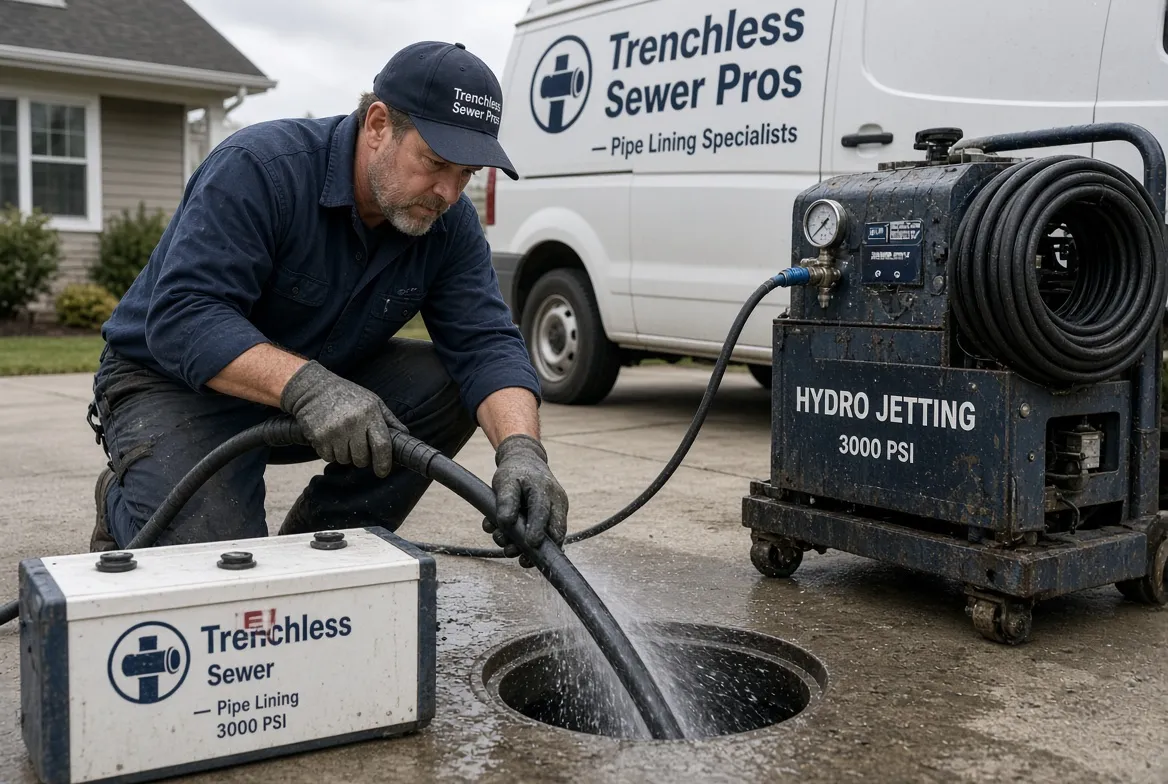
Hydro Jetting
High-pressure water scours the pipe wall back to bare material — grease, sludge, scale and roots all go.
Cutting roots restores flow today. Sealing the joint they entered through is what stops them coming back.
Tree roots are the most common cause of sewer line failure in older American neighbourhoods, and they are relentless. A root does not break into a sound pipe — it finds a defect that is already there and exploits it.
We cut the roots out to restore flow, and then we tell you the part most companies leave out: unless the opening they came through is sealed, they will be back. Usually within one to three years.
Ohio combines the two conditions that produce severe root intrusion: a housing stock old enough to be served by jointed clay tile, and the mature street-tree canopy that established neighbourhoods across the state are known for.
Silver maple, willow, poplar and American elm are particularly aggressive, and sixty-year-old specimens have root systems that comfortably reach a lateral running under the front lawn. The roots do not break into sound pipe — they find a joint that has already worked loose through decades of freeze-thaw soil movement.
A sewer line carries warm, nutrient-rich water. In dry conditions that is the most attractive thing in the soil, and roots grow toward the vapour escaping from any gap.
The gap is almost always at a joint. Clay tile — the residential standard from the 1880s into the 1980s — was laid in short sections with mortared or gasketed joints, and those joints are the weak point. Once a hair root passes through, it thickens, widens the opening, and eventually displaces the pipe section itself.
Orangeburg, a bituminous fibre pipe used heavily in post-war construction, fails differently: it deforms out of round and delaminates, and roots invade the resulting splits. Cast iron resists roots until corrosion opens a path.
We will be straight about this because it determines whether you spend money twice. Mechanical cutting and jetting remove the root mass inside the pipe. They do not close the crack, joint or hole the roots used to get in.
If your line is otherwise sound and the intrusion is light, scheduled cutting every year or two is a perfectly rational maintenance choice. If you are cutting roots every few months, or the camera shows the joints are failing along the run, you are renting a solution. Lining the pipe creates a continuous jointless interior with nothing for roots to enter — that is the permanent fix.
Foaming root control products containing herbicides such as dichlobenil or metam-sodium can kill root tissue inside the pipe and slow regrowth. They have a legitimate place as a maintenance supplement between cuttings.
They have real limits. They do not remove an established root mass, they do not repair the defect, and they must be applied correctly — some formulations are restricted-use and misapplication can damage the tree or contaminate soil. Copper sulphate poured down a toilet, the classic hardware-store advice, mostly settles in the trap and achieves very little.
This comes up on nearly every Ohio root job, so to be clear: the pipe is the problem, not the tree. Once the lateral is lined there is no opening for roots to exploit, and a mature tree can stay exactly where it is.
Removing a healthy shade tree while leaving a cracked clay joint in the ground fixes nothing — the next tree's roots behave identically.
The process
We confirm roots are the cause, see how far the intrusion runs, and assess whether the pipe around it is still structurally sound.
A root-cutting head sized to the pipe is driven through the line, shearing roots back to the wall.
Hydro jetting clears the cut debris — leaving it in place just forms the next blockage.
A second camera pass shows the bare pipe wall and, crucially, the exact defect the roots were using.
Recurring maintenance, a targeted spot repair if it is one joint, or full lining if the run is failing. You get the footage either way.
Answers
A straightforward cutting and clearing visit typically runs $200 to $800. Heavy, established intrusion needing multiple passes, jetting and camera work can reach $2,800. A permanent fix through lining is a larger investment that stops the recurring bills.
Common signs are repeated backups in the same line, gurgling toilets, slow drains across several fixtures, and unusually lush or soggy ground along the sewer route. A camera inspection confirms it in under an hour — root intrusion is unmistakable on video.
If the defect stays open, yes — typically within one to three years, faster with aggressive species like willow, poplar and silver maple. Cutting manages the symptom. Sealing the pipe is what ends it.
Almost never. The pipe is the problem, not the tree. Once the line is lined or repaired there is no opening for roots to exploit, and a mature tree can stay. Removing a healthy tree while leaving a cracked pipe fixes nothing — the next tree's roots behave the same way.
Roots do not penetrate sound, sealed pipe. They enter at an existing crack, an open joint or a failed seal. On an old clay line, those openings are a function of age, soil movement and freeze-thaw cycling — the roots simply find them.
Keep reading
High-pressure water scours the pipe wall back to bare material — grease, sludge, scale and roots all go.
A resin-saturated liner is installed inside the old pipe and cured hard, forming a new jointless pipe within a pipe.
One bad joint doesn't justify a whole new line. A sectional liner repairs just the damaged length.
Lines back up at the worst possible time. We answer 24/7, anywhere in the country, and every repair quote starts with a camera inspection so you see the pipe before you spend a dollar.